
Rocznik Ochrona Środowiska (Annual Set the Environment Protection) is a peer-reviewed scientific journal published under the Open Access model. Full-text articles are freely available under the CC BY-SA 4.0 licence. The journal follows the principles of publication ethics established by the Committee on Publication Ethics (COPE).
Manuscript Preparation
Manuscripts must be prepared in English, submitted in DOC or DOCX format, and comply with the journal’s editorial and technical requirements.
Before submission, authors should verify the accuracy of:
- author names, affiliations, ORCID identifiers, and the corresponding author’s e-mail address;
- the structure, language, and formatting of the manuscript;
- tables, figures, charts, and references;
- statements concerning funding, conflicts of interest, and data availability;
- required declarations concerning research ethics and the use of artificial intelligence tools.
Manuscript Submission
Manuscripts must be submitted through the online manuscript submission system.
By submitting a manuscript, the authors confirm that:
- the work is original and does not constitute plagiarism or self-plagiarism;
- the manuscript has not been previously published and is not under consideration by another journal;
- all authors have approved the final version of the manuscript and consent to its submission;
- the authors accept the journal’s editorial procedures and publication charges.
The corresponding author is responsible for communication with the Editorial Office and for forwarding all editorial decisions, reviewers’ comments, and other correspondence to the co-authors.
Editorial Process
The editorial and publishing workflow is presented in the flowchart below.
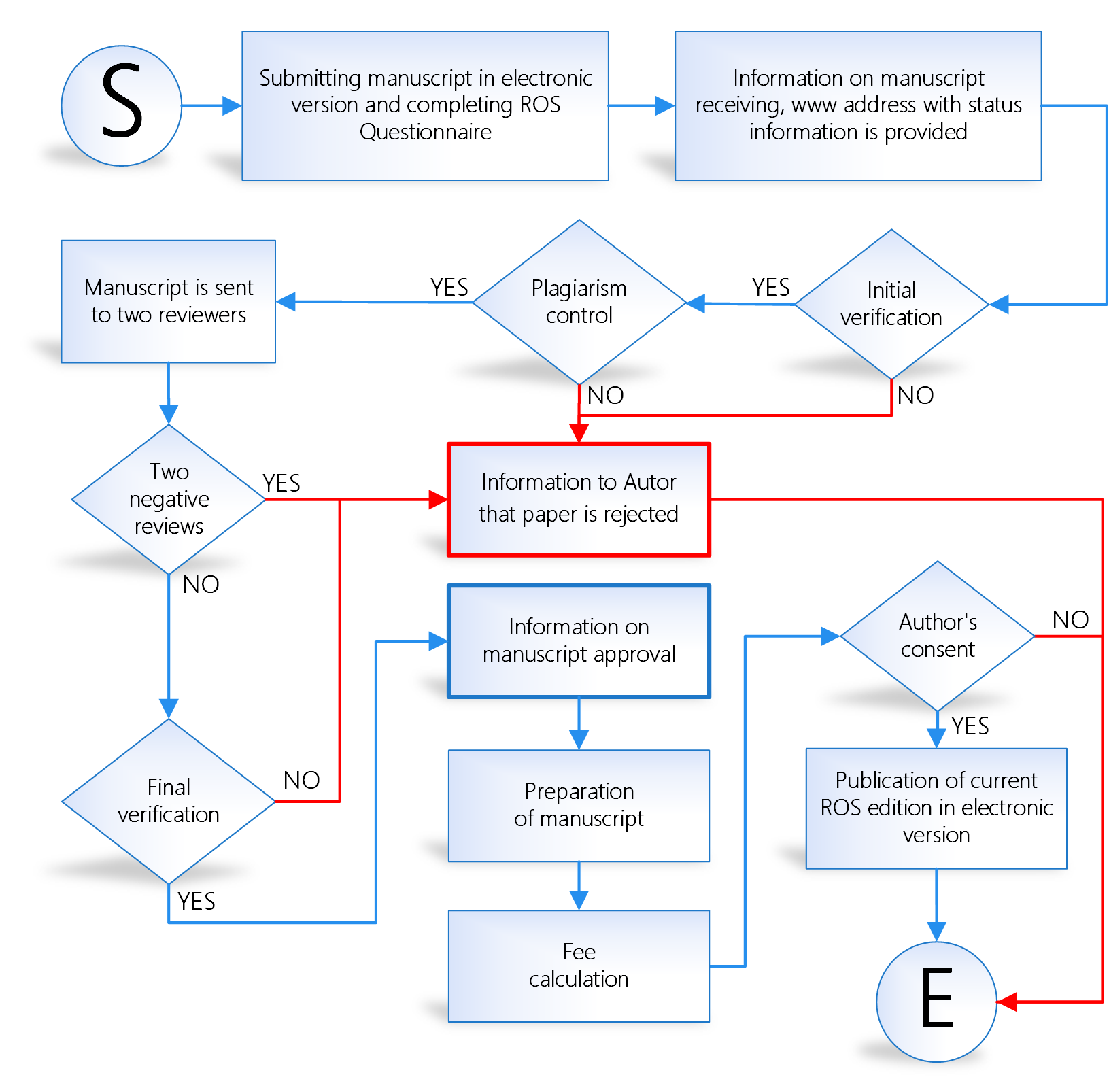
Upon receipt of a submission, the Editorial Office acknowledges its receipt and conducts:
- an initial editorial assessment;
- plagiarism screening;
- peer review;
- final editorial verification;
- preparation of the accepted manuscript for publication.
A negative outcome at the initial assessment, plagiarism screening, peer review, or final editorial verification may result in rejection of the manuscript.
Peer Review
Each manuscript meeting the initial requirements is evaluated by two independent reviewers with expertise in the relevant subject area.
Reviewers must not:
- be affiliated with the same institution as any of the authors;
- have any personal, professional, or financial relationship with the authors that could create a conflict of interest;
- use or disclose any unpublished content contained in the manuscript.
Review reports are confidential internal documents of the Publisher. The final decision regarding the acceptance or rejection of a manuscript rests with the Editorial Board.
Revision of the Manuscript
If a revision is requested, the authors should submit:
- the revised manuscript;
- a detailed response to all comments made by the reviewers and the Editorial Office;
- a clear indication of all changes introduced in the manuscript;
- a justification for any comments or recommendations that were not addressed.
Responses should be complete, factual, and submitted within the specified deadline.
Authorship, Funding, and Conflicts of Interest
Only individuals who have made a substantial contribution to the preparation of the manuscript, approved its final version, and accepted responsibility for its content may be listed as authors.
Authors are encouraged to describe their individual contributions in accordance with the CRediT taxonomy.
Each manuscript must include:
- information on funding sources;
- a declaration of conflicts of interest or a statement confirming that no conflicts exist;
- a data availability statement;
- all required information concerning ethical approval.
The Editorial Office may request source data, measurement results, original graphics, or other materials necessary to verify the integrity and reliability of the research.
Use of Artificial Intelligence
Generative artificial intelligence tools must not be listed as authors. Any use of such tools in drafting or substantially editing a manuscript must be disclosed by stating the name of the tool and the purpose for which it was used.
The authors remain fully responsible for the accuracy, originality, and reliability of the entire manuscript, including all citations and references.
If artificial intelligence formed part of the research methodology, its application must be described in sufficient detail to enable the procedure to be reproduced.
Article Processing Charge
The Article Processing Charge (APC) for an accepted manuscript is PLN 1,000 plus VAT, or the equivalent amount in EUR or USD.
For payments made from outside the European Union, all bank transfer charges must be covered by the author, co-author, or organisation named on the invoice.
The APC is charged only after the manuscript has been accepted for publication. The corresponding author is informed of the publication fee before production begins. Failure to accept the publication charge results in termination of the publication process.
Publication
After acceptance and confirmation of the publication charge, the manuscript is prepared for publication in accordance with the journal’s production standards.
The Editorial Office may introduce linguistic, stylistic, technical, typographical, and bibliographic corrections, as well as minor editorial revisions, provided that they do not alter the scientific findings or substantive content of the manuscript.
Accepted articles are published online in English on the journal’s website. At the end of each calendar year, they are also published in printed form.
Confidentiality
All submitted manuscripts, author information, peer-review reports, and editorial correspondence are treated as confidential.
The Editorial Office ensures the secure processing of personal data and the protection of unpublished research results and supporting materials.